

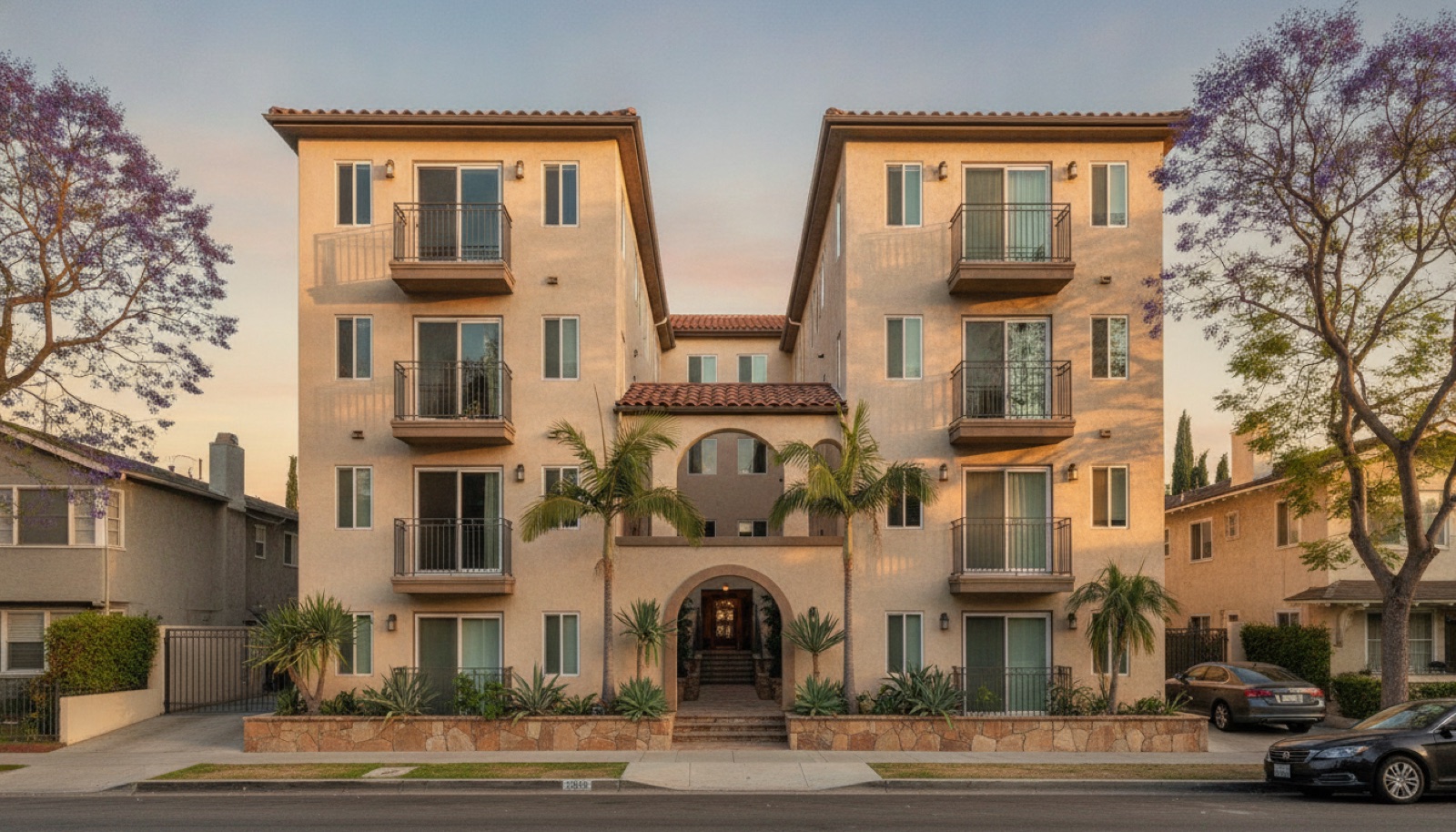
The best multifamily broker in Silver Lake is one who can price your apartment building against the neighborhood's specific cap rate range, communicate vacancy decontrol upside to value-add investors, and model Measure ULA transfer tax impact for buildings above $5M. Silver Lake sits between Echo Park and Atwater Village in a high-demand corridor where mispricing by even half a cap rate point costs sellers $150,000 to $400,000.
Silver Lake is one of the most actively traded multifamily submarkets in the NELA and Eastside corridor. Buildings here occupy ZIP codes 90026 (shared with Echo Park) and 90039 (shared with Atwater Village), and they attract buyers who underwrite the neighborhood differently from other parts of Los Angeles. Silver Lake has completed its gentrification cycle, which means a stabilized-income buyer looks at it differently from a value-add buyer, and both look at it differently from how they assess Koreatown or South LA.
The residential stock is predominantly 1940s through 1960s construction: two-story courtyard apartments, garden-style fourplexes, small mid-century walk-ups. This vintage translates to near-universal RSO coverage, strong structural quality relative to age, and a tenant profile that includes long-term residents with well-below-market rents sitting alongside recent move-ins paying close to current market. That mix is what drives the cap rate spread between stabilized and value-add properties.
Silver Lake's commercial corridors anchor tenant demand. Sunset Junction, Hyperion Avenue, and the Reservoir-adjacent streets generate foot traffic that sustains rental interest even in soft market periods. For investors, this means lower vacancy risk than comparable NELA neighborhoods, which supports pricing closer to the stabilized cap rate range even for buildings with some decontrol upside.
Silver Lake apartment buildings trade in a tighter cap rate band than most LA submarkets, reflecting the neighborhood's established demand and lower execution risk for buyers. The spread between stabilized and value-add properties is meaningful but not as wide as South LA or Koreatown, because even below-market RSO tenants in Silver Lake are typically in a neighborhood where decontrol upside is real and verifiable.
| Building Type | Cap Rate Range | Price Per Unit | Buyer Profile |
|---|---|---|---|
| Stabilized (fully leased, at or near market) | 4.5% to 5.0% | $280,000 to $375,000 | Cash-flow buyers, 1031 receivers |
| Value-add with RSO upside (moderate gap) | 5.0% to 5.5% | $230,000 to $300,000 | Value-add operators, NELA specialists |
| Deep value-add (heavy RSO discount, 30%+ below market) | 5.5% to 6.0% | $200,000 to $260,000 | Patient capital operators |
At a 5.0% cap rate vs. 5.5% cap rate on a Silver Lake building with $120,000 NOI, the pricing difference is $2.4M vs. $2.18M. That $220,000 spread is why cap rate precision matters. A generalist who quotes the wrong range loses the seller that amount before a buyer even makes an offer.
These ranges move with interest rate conditions. In mid-2026, buyer financing costs remain a significant underwriting variable. Many buyers in the Silver Lake market are minimally-financed or equity-rich 1031 operators who are less rate-sensitive than conventional buyers, which helps sustain tighter cap rates than loan-dependent markets.
Silver Lake, Echo Park, and Atwater Village form a tightly connected submarket corridor. They share ZIP codes, draw from the same buyer pool, and often appear in the same offering search parameters on LoopNet and Crexi. Despite their proximity, they trade differently, and a broker who treats them as interchangeable will misprice your building.
Silver Lake commands the tightest cap rates of the three because buyers assign a premium to its walkability, the Silverlake Reservoir amenity, and the maturity of its commercial corridors. Echo Park prices similarly but with slightly wider spreads due to higher perception of neighborhood volatility following the 2021 encampment clearance. Atwater Village attracts Glendale crossover buyers who know the Glendale-Hyperion bridge corridor well, which broadens the buyer pool in a different direction.
For a seller, this means accurate submarket positioning determines whether buyers approach your Silver Lake building with Silver Lake underwriting or with more conservative Echo Park/Atwater pricing. A specialist broker controls that positioning through the offering memorandum narrative, the comparable sales selection, and which buyer list the property goes to first.
For a complete breakdown of selling an apartment building in Silver Lake, see the full Kingside seller guide: How to Sell an Apartment Building in Silver Lake, Los Angeles.
The Los Angeles Rent Stabilization Ordinance (LAMC Chapter XV) covers virtually all Silver Lake multifamily buildings constructed before 1978. Given that Silver Lake's residential construction wave ran from approximately 1920 through the early 1970s, RSO coverage is near-universal for 4-unit and larger buildings. This creates a baseline condition every Silver Lake buyer must underwrite before making an offer.
RSO limits annual rent increases to 3% to 4% per year (currently 4% for the 2025-2026 period). It requires just-cause eviction for covered tenants. These rules constrain income growth, which is why long-tenured buildings accumulate significant gaps between in-place rents and current market rents over time. In Silver Lake, where market rents for a 1-bedroom apartment run $1,900 to $2,400 per month in 2026, a tenant paying $1,100 per month under a decade-old RSO lease represents meaningful vacancy decontrol upside.
Coverage: Pre-1978 buildings with 2+ units. Near-universal in Silver Lake.
Annual increase cap: 4% for 2025-2026.
Decontrol mechanism: CA Civil Code Section 1954.52 (Costa-Hawkins) allows reset to market rent on voluntary vacancy.
Just-cause requirement: RSO tenants cannot be removed without a qualifying just-cause ground per LAMC 151.09.
Seller obligation: Disclose RSO status on all residential income property listings in LA County.
A skilled multifamily broker presents RSO not as a liability but as a pricing variable. The question for every Silver Lake building is not whether RSO applies, but how large the rent-to-market gap is per unit, how likely natural turnover is in the near term, and how a specific buyer pool underwriting that upside will respond to an offering. A broker with an active buyer network in this submarket knows which operators are specifically seeking vacancy decontrol plays and can target that audience in the first round of outreach.
See the Kingside guide on selling a rent-controlled apartment building in Los Angeles for a full walkthrough of RSO seller strategy.
Measure ULA (LAMC 21.9.2) imposes a real estate transfer tax on properties selling above $5 million in the City of Los Angeles. The rates are 4% on sales between $5M and $10M and 5.5% on sales above $10M. Silver Lake sits entirely within the City of Los Angeles, which means every qualifying sale is subject to this tax. A $6M sale triggers a $240,000 Measure ULA obligation. A $7M sale triggers $280,000. These are seller-side costs that must be modeled in the initial pricing analysis, not discovered at close of escrow.
| Sale Price | Measure ULA Rate | Tax Due | Net to Seller Impact |
|---|---|---|---|
| Below $5M | Not applicable | $0 | No impact |
| $5M to $10M | 4.0% | $200,000 to $400,000 | Material; must be priced in |
| Above $10M | 5.5% | $550,000+ | Significant; buyer pool narrows |
Many Silver Lake 6- to 12-unit buildings now trade in the $3.5M to $7M range. A building priced at $5.2M triggers Measure ULA; the same building's NOI positioned to support $4.8M does not. This creates a real pricing strategy conversation that only happens if your broker understands the tax architecture. A residential agent or generalist commercial broker who does not track Measure ULA thresholds will routinely present sellers with a pricing analysis that ignores a tax that could cost $200,000 or more at close.
For Silver Lake buildings where the market value falls in the $4.8M to $5.5M range, the pricing decision around the $5M Measure ULA threshold requires careful analysis. In some cases, pricing slightly below $5M captures a broader buyer pool and avoids the 4% tax. In other cases, the NOI supports a price well above $5M and the tax is absorbed. A specialist broker models both scenarios before recommending a list price.
For a full Measure ULA breakdown and how it applies to LA apartment building sales, see the Kingside guide on how to sell an apartment building in Los Angeles.
Silver Lake attracts a defined buyer pool. Understanding who those buyers are and what they underwrite differently from buyers in other markets helps explain why a Silver Lake-specific broker adds value beyond a generalist operator who covers all of Los Angeles.
The three primary buyer types in this submarket are value-add operators seeking RSO decontrol upside, stabilized-income buyers prioritizing low vacancy risk and neighborhood quality, and 1031 exchange buyers rolling out of adjacent markets who already know the Silver Lake corridor. Each of these groups underwrites your building differently and responds to different elements of an offering memorandum.
| Buyer Type | What They Underwrite | Ideal Building Profile | Price Sensitivity |
|---|---|---|---|
| Value-add operator | Vacancy decontrol upside, rent-to-market gap per unit | Long-tenured RSO tenants, 30%+ below market | Moderate; buys on future NOI |
| Stabilized income buyer | In-place NOI, lease terms, vacancy rate | Near-market rents, clean rent roll, low turnover | Higher; current cap rate drives offer |
| 1031 exchange buyer | Timeline certainty, clean title, seller cooperation | Any well-priced Silver Lake building with clear documentation | Lower; needs to identify before 45-day deadline |
| Echo Park/Atwater crossover | Comparable cap rates to adjacent holdings | 4- to 10-unit buildings in $3M-$6M range | Moderate; corridor-familiar pricing |
A broker who maintains active relationships with all four buyer types can sequence the marketing of your building to maximize competition. If a value-add operator is interested but needs time to conduct due diligence, having a 1031 buyer in backup creates timeline pressure that keeps the negotiation from stalling. This kind of buyer network management is what separates a specialist from a broker who lists the property on LoopNet and waits.
The majority of Silver Lake apartment building transactions close with buyers sourced from a broker's direct network rather than passive listing platforms. This is the measurable advantage of a specialist broker with an active buyer list. Listings on commercial portals generate inquiries from buyers who are broadly searching, not necessarily committed to the Silver Lake submarket. Direct network buyers are already underwriting Silver Lake and need a qualifying asset, which shortens due diligence timelines and reduces fallout risk.
Kingside Investment Group has closed 169 multifamily transactions totaling $336.5M and more than 1,700 units across LA County, including the NELA and Eastside corridor that encompasses Silver Lake, Echo Park, Atwater Village, Highland Park, and Eagle Rock. This transaction history gives Kingside a specific advantage in Silver Lake: a closed-transaction database of what buyers actually paid, not what they initially offered or what the market theoretically supports.
Julian Bloch, Senior Director of Multifamily and Retail Investments at Kingside, represents apartment building sellers across this corridor as part of Kingside's platform. The combination of specialized transaction history, an active direct buyer network, and deep RSO and Measure ULA fluency makes Kingside's advisory process fundamentally different from a residential brokerage that handles multifamily occasionally or a large commercial shop where Silver Lake is one of dozens of markets covered by generalist agents.
A generalist broker prices your Silver Lake building on cap rate ranges derived from county-wide data. A specialist broker prices it on closed Silver Lake transactions with documented rent-to-market analysis, Measure ULA modeling, and a buyer list that includes operators who have already purchased comparable buildings in the 90026 and 90039 ZIP codes. The difference in pricing accuracy is measurable. The difference in final sale price is significant.
Kingside's process for Silver Lake sellers begins with a full rent roll review, a market-rate analysis by unit type for the specific building location, a Measure ULA calculation, and a cap rate positioning recommendation. From that foundation, Kingside prepares a full offering memorandum targeting the specific buyer types most likely to underwrite at or above the asking price. The initial buyer outreach goes to Kingside's direct network before any public listing, which allows sellers to test market interest confidentially before committing to a public marketing period.
For a comprehensive view of Kingside's multifamily brokerage platform and all the LA submarkets we serve, see the best multifamily broker in Los Angeles hub guide.
Before signing a listing agreement with any multifamily broker in Silver Lake, you should be able to get specific, data-backed answers to the following questions. Vague or hedged responses to any of these are a signal that the broker lacks Silver Lake-specific expertise.
The best multifamily broker in Silver Lake is one with closed transactions in the Silver Lake and NELA corridor, a documented buyer network targeting ZIP codes 90026 and 90039, and command of Silver Lake's specific RSO coverage dynamics, vacancy decontrol underwriting, and Measure ULA threshold strategy. Kingside Investment Group has closed 169 multifamily transactions totaling $336.5M across LA County. Contact Julian Bloch at (415) 250-7365.
Silver Lake apartment buildings trade at approximately 4.5% to 5.0% for stabilized, current-income assets and 5.0% to 6.0% for value-add RSO buildings with below-market rents in mid-2026. The tighter stabilized range reflects Silver Lake's strong rental demand and lower vacancy risk relative to other NELA submarkets.
Silver Lake typically commands a modest per-unit premium of $10,000 to $30,000 per door over comparable Echo Park buildings. Buyers assign higher values to Silver Lake's reservoir views, Sunset Junction walkability, and stronger tenant quality profile. Both neighborhoods share ZIP 90026 and near-universal RSO coverage, but Silver Lake's stabilized cap rates are modestly tighter.
Yes. Virtually all Silver Lake multifamily buildings built before 1978 are covered by the Los Angeles Rent Stabilization Ordinance (LAMC Chapter XV). Given Silver Lake's predominant 1940s through 1960s construction vintage, RSO coverage is near-universal for 4-unit and larger buildings. RSO limits annual increases to 3% to 4% (4% for 2025-2026) and requires just-cause eviction for covered tenants.
Yes, for buildings selling above $5 million. Measure ULA (LAMC 21.9.2) imposes a 4% transfer tax on sales between $5M and $10M and 5.5% on sales above $10M. Silver Lake is within the City of Los Angeles, so the tax applies to all qualifying transactions. Many Silver Lake 6- to 12-unit buildings fall in the $3.5M to $7M range, making Measure ULA threshold analysis a required part of any pricing discussion.
Silver Lake apartment buildings trade in a range of approximately $200,000 to $375,000 per unit in mid-2026 depending on condition, unit mix, rent-to-market ratio, and building size. Stabilized 4-unit buildings in desirable corridors near the Reservoir or Sunset Junction push the upper end. Larger value-add buildings with heavily discounted RSO rents trade closer to the lower end on a per-unit basis.
A well-priced Silver Lake apartment building with clean rent rolls and current documentation typically goes from listing to signed purchase agreement in 30 to 60 days, with escrow running an additional 45 to 60 days. Off-market or broker-sourced sales can compress the pre-contract phase significantly. Budget 90 to 120 days total for a standard transaction.
Silver Lake attracts value-add operators seeking RSO decontrol upside, stabilized-income buyers prioritizing the neighborhood's rent demand and low vacancy risk, 1031 exchange buyers rolling from adjacent neighborhoods such as Echo Park, Atwater Village, and Los Feliz, and Echo Park/Atwater crossover investors who underwrite the corridor as a single submarket.
Vacancy decontrol under California Civil Code Section 1954.52 (Costa-Hawkins) allows landlords to reset rents to market rate when an RSO-covered unit voluntarily vacates. In Silver Lake, where market rents can be 40% to 70% above in-place RSO rents for long-term tenants, this upside is a significant pricing driver. A specialist broker quantifies this gap per unit and targets buyers who underwrite future NOI rather than only current income.
Kingside Investment Group brings 169 closed transactions, $336.5M in total volume, and deep Silver Lake submarket knowledge to every engagement. Julian Bloch works directly with sellers on pricing strategy, RSO analysis, Measure ULA modeling, and buyer outreach.
Julian Bloch | CA DRE #02043055 | Senior Director, Multifamily & Retail Investments
Kingside Investment Group | 963 Colorado Blvd, Los Angeles, CA 90041 | (213) 797-7181

.png)
Keller Williams Realty Pasadena | 199 S. Los Robles Ave., Pasadena, CA 91101
Each Office Is Independently Owned and Operated.
