


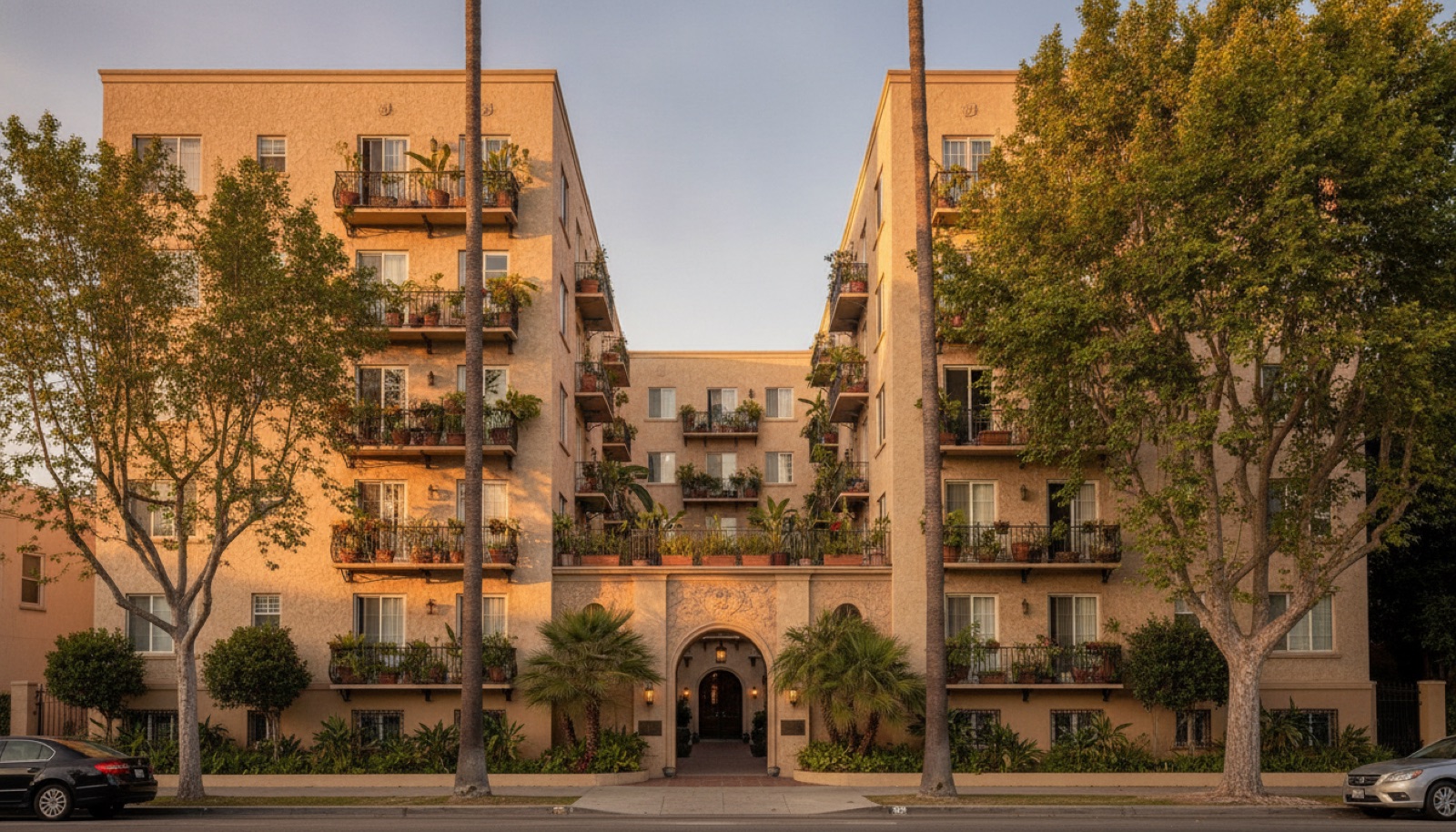
Atwater Village apartment buildings are trading at cap rates of 4.8% to 5.5% for stabilized assets with current income in mid-2026, and 5.5% to 6.0% for value-add buildings with below-market rents and significant vacancy decontrol potential. The neighborhood sits between Silver Lake and Glendale on the LA River, bounded by Los Feliz to the south and Glendale city limits to the north.
Atwater Village is one of the most tightly held multifamily submarkets in Northeast Los Angeles, and for good reason: Atwater Village combines a residential village scale that Silver Lake and Echo Park cannot replicate, strong appreciation that tracks the broader NELA corridor, and a Glendale-adjacent buyer pool that consistently produces competitive offers on well-positioned assets.
The Glendale Boulevard corridor is the defining commercial and residential spine of Atwater Village. Nearly all of the neighborhood's most sought-after multifamily inventory sits within walking distance of Glendale Boulevard's independent restaurants, coffee shops, and local retailers between Fletcher Drive and Verdugo Road. That walkability premium is real and measurable: buildings on or within two blocks of Glendale Boulevard consistently command tighter cap rates than equivalent buildings in interior streets. The LA River Bike Path, which runs along the western boundary of Atwater Village, has become a genuine recreational amenity that buyers cite when comparing the neighborhood to nearby Echo Park or parts of Silver Lake where similar outdoor infrastructure does not exist.
The building stock is what every Atwater Village seller needs to understand before engaging any broker. The vast majority of Atwater Village multifamily inventory was constructed in the 1940s through the 1960s. That vintage means near-universal RSO coverage, a vacancy decontrol dynamic that is the central underwriting story for every institutional and exchange buyer operating in this submarket, and a rent roll profile where below-market tenancies represent value rather than liability when presented correctly. Sellers who understand how to tell the decontrol story in an offering memorandum approach the market from a position of strength. Those who do not often price based on current-income assumptions and leave material value on the table.


GET YOUR ATWATER VILLAGE BUILDING'S CURRENT VALUE
Kingside has closed 169 multifamily transactions totaling $336.5M across LA County. Call Julian for a no-obligation current-market pricing analysis on your Atwater Village building.
Call (415) 250-7365 Text Julian julianbloch@kw.comAtwater Village's Multifamily Market in Mid-2026
Atwater Village occupies a distinct position in the Northeast Los Angeles multifamily hierarchy. It is not an early-stage discovery market the way parts of Glassell Park were five years ago, nor is it as densely traded as Silver Lake or Highland Park. It is a neighborhood that gentrified steadily through the 2010s and has settled into a mature appreciation trajectory, supported by strong tenant demand, limited inventory turnover, and a buyer base that prizes the residential scale and relative quiet that Glendale Boulevard's village character provides compared to the higher-density commercial activity of nearby Silver Lake or Echo Park.
The transaction market in Atwater Village reflects that maturity. Buildings that are well-documented, positioned with a clear vacancy decontrol argument, and priced in relation to actual mid-2026 market conditions rather than the 2021 and 2022 peak generate multiple offers within two to three weeks. The buyer pool is disciplined, meaning buyers who are underwriting Atwater Village have done the work and are not easily surprised. The best outcomes come when the seller's offering memorandum anticipates what the buyer is going to model and presents the answer before the question is asked. That is the job of the broker, and it is the primary variable that separates outcomes in this submarket.
Transaction volume in Atwater Village has been constrained by the same financing environment that has affected the broader LA multifamily market since mid-2022. Buyers using debt require cap rates that support positive leverage at current interest rates, which has pushed demand toward value-add assets where the decontrol premium provides a compelling return profile even at today's debt costs. All-cash buyers and 1031 exchange operators with large equity stacks have remained active throughout. The Glendale-adjacent buyer flow has been a particularly consistent source of demand: investors based in or familiar with Glendale understand the Glendale Boulevard corridor, know the neighborhood's trajectory, and are often motivated by cap rate differentials relative to comparable Glendale assets.
| Building Type | Cap Rate Range (Mid-2026) | Primary Buyer Motivation | Typical Unit Count |
|---|---|---|---|
| Stabilized, current rent roll, well maintained | 4.8% – 5.2% | 1031 exchange, income preservation, NELA entry | 4 – 8 units |
| Below-market rents, strong decontrol pipeline | 5.0% – 5.5% | Vacancy decontrol upside, long-hold operators | 6 – 16 units |
| Mixed rents, some deferred maintenance | 5.3% – 5.8% | Value-add repositioning, decontrol plus capital improvement | 4 – 12 units |
| Significant deferred maintenance, below-market rents | 5.6% – 6.0% | Repositioning buyers, deep value-add thesis | Any size |
How Does RSO Rent Control Apply in Atwater Village?
The Los Angeles Rent Stabilization Ordinance applies to all residential rental units in buildings constructed before October 1, 1978. Atwater Village's multifamily building stock was built predominantly in the 1940s, 1950s, and 1960s. The practical result for Atwater Village sellers: RSO coverage is essentially universal. A post-1978 building would be a genuine rarity in this submarket, and even those rare newer buildings may fall under AB 1482's statewide rent cap, which imposes a maximum annual rent increase of 5% plus the local Consumer Price Index, not to exceed 10% per year, if the building has been occupied for 15 or more years as of the sale date (California Civil Code Section 1946.2).
The current RSO allowable annual rent increase for 2025–2026 is 4%, based on the Consumer Price Index adjustment applied by the Los Angeles Housing Department (LAHD). This ceiling on rent growth for existing tenants is the structural feature of every Atwater Village income property. In a neighborhood where market rents for a one-bedroom unit can reach $1,900 to $2,600 per month, a long-term RSO tenant paying $950 or $1,150 per month on that same unit represents a below-market spread of 40% to 60%. That spread is not a liability for sellers. It is the central value argument in any Atwater Village offering memorandum, because it represents the decontrol premium that every experienced buyer in this submarket is modeling at acquisition.
RSO also governs just-cause eviction requirements. Atwater Village landlords may only remove tenants for specific reasons listed under the RSO, including non-payment of rent, breach of a material lease term, owner or relative move-in (subject to tenant relocation assistance requirements), and certain rehabilitation circumstances (LAHD Rent Stabilization Ordinance, 2025). Sellers need to confirm before listing that no active eviction proceedings are in a contested state, that no outstanding relocation obligations exist, and that all annual LAHD registration filings are current. Any of these issues will surface in due diligence and become negotiation points that were entirely avoidable with pre-listing preparation.
One RSO nuance that Atwater Village sellers occasionally underestimate: buildings with units that have been occupied since the late 1970s or early 1980s may carry rents that are extraordinarily low because 3% to 4% annual increases compounded from that era produce numbers that bear no relationship to current market conditions. A studio renting at $650 per month in a building where comparable units are generating $1,500 is not a problem. It is an asset, because every buyer who underwrites that building is modeling the income jump that occurs when that unit turns. Presenting those long-tenancy units accurately, with current market rent comparables and a reasonable turnover projection, is a skill that distinguishes a specialist broker from a generalist. The difference in offer price can be $200,000 or more on a mid-size Atwater Village building.
RSO COMPLIANCE REVIEW INCLUDED
Kingside reviews LAHD registration status, outstanding relocation obligations, and pending notices on every Atwater Village listing before going to market. No surprises in due diligence.
Call (415) 250-7365 Text Julian julianbloch@kw.comHow Do Buyers Underwrite Vacancy Decontrol in Atwater Village?
Vacancy decontrol is the mechanism established under California's Costa-Hawkins Rental Housing Act (California Civil Code Section 1954.52) by which a Los Angeles RSO landlord may reset a rent-controlled unit's rent to current market rate when a tenant voluntarily vacates. The operative word is voluntarily: RSO units cannot be reset to market through eviction except for specific just-cause reasons, which means the decontrol calendar is governed by tenant decisions rather than owner decisions. Buyers who are experienced in the Atwater Village market build a unit-by-unit turnover model and factor the projected income increase from each decontrol event into their acquisition price.
In Atwater Village, where market rents for a one-bedroom run approximately $1,900 to $2,400 per month and long-tenancy RSO rents on comparable units can be $900 to $1,300, the decontrol spread on a single unit is often $600 to $1,500 per month. On a seven-unit building with four long-tenancy units, that is $2,400 to $6,000 per month in income upside at full stabilization, or $28,800 to $72,000 in additional annual Net Operating Income when the building cycles through. Capitalized at a 5.0% going-in rate, the value represented by those decontrol events is $576,000 to $1,440,000 above what current-income-only underwriting would produce. Buyers price this. The offering memorandum that presents it clearly and documents it with current market rent comparables generates measurably higher offers than the offering memorandum that ignores it or buries it in an appendix.
| Unit Type | Typical RSO Rent (Long-Tenancy) | Current Market Rent | Decontrol Uplift on Vacancy |
|---|---|---|---|
| Studio | $700 – $950 | $1,450 – $1,750 | $500 – $1,050/month |
| 1 Bedroom | $900 – $1,300 | $1,900 – $2,400 | $600 – $1,500/month |
| 2 Bedroom | $1,100 – $1,600 | $2,400 – $3,100 | $800 – $2,000/month |
| 3 Bedroom | $1,400 – $1,900 | $3,000 – $3,800 | $1,100 – $2,400/month |
The turnover modeling in a professional Atwater Village offering memorandum goes beyond listing current rents versus market rents. It estimates the probability and timing of turnover by unit based on tenancy length, known circumstances, and the building's historical turnover rate. A building where three units have been occupied for 20 or more years and one long-tenancy tenant is in their 80s produces a different decontrol timeline model than a building where all below-market units have been occupied for eight to twelve years. Buyers who see this level of analysis in the OM do not have to run their own pessimistic assumptions. They compete on the seller's terms rather than discounting for uncertainty.
Measure ULA and What It Means for Atwater Village Sellers
Measure ULA, passed by Los Angeles voters in November 2022 and effective April 1, 2023, imposes an additional transfer tax on the sale of City of Los Angeles real property above certain price thresholds (Los Angeles Municipal Code Section 21.9.2). The tax applies as follows: 4% on the full sale price for transactions between $5,000,000 and $10,000,000, and 5.5% on the full sale price for transactions above $10,000,000. There are no exemptions for apartments, multifamily assets, or 1031 exchange transactions. Measure ULA applies to the full consideration paid, not just the amount above the threshold.
For Atwater Village sellers, the practical impact depends entirely on building size and sale price. The majority of Atwater Village multifamily transactions involve 4-to-12-unit buildings that trade below the $5 million threshold and are therefore not subject to Measure ULA. A well-positioned six-unit Atwater Village building with a strong vacancy decontrol argument might sell for $2.8 million to $3.6 million in mid-2026, well below the Measure ULA trigger. Larger buildings in the 10-to-16-unit range, particularly those on or near the Glendale Boulevard corridor with strong current income and multiple below-market tenancies, can approach or exceed $5 million, at which point Measure ULA becomes a real net proceeds consideration.
Sellers of larger Atwater Village buildings approaching the $5 million threshold should also understand the interaction between Measure ULA and the base LACTT (Los Angeles County Transfer Tax) of $1.10 per $1,000 of consideration, and the City of Los Angeles Documentary Transfer Tax of $4.50 per $1,000 of consideration. Measure ULA is additive to those standard taxes, not a replacement. On a $5.1 million Atwater Village sale, the total transfer tax burden including ULA would be approximately $235,000. On a $4.9 million sale, the same base taxes apply but ULA does not, producing a total transfer tax burden of approximately $27,000. The strategic implications are significant and should be modeled explicitly before pricing and marketing decisions are made.
What Makes Atwater Village Different From Neighboring Submarkets
Atwater Village is frequently grouped with Silver Lake, Echo Park, and Los Feliz as part of the same general NELA or "Eastside" multifamily market. That grouping is not wrong, but it obscures meaningful differences that affect how sellers should position their buildings and which buyers are most likely to compete for them. Understanding the submarket distinctions is not academic. It determines which broker database produces the best buyer pool, how the offering memorandum should frame the neighborhood, and what comparable sales are most relevant when building the pricing argument.
The most significant distinction between Atwater Village and Silver Lake is density and commercial character. Silver Lake's Sunset Boulevard corridor and its lakeside residential density create a more urban feel with higher foot traffic, more nightlife venues, and correspondingly higher buyer demand from tenants in their 20s and early 30s. Atwater Village's Glendale Boulevard commercial corridor has a quieter, more neighborhood-serving character: independent bookshops, local cafes, and a farmers market rather than a bar scene. That distinction attracts a different tenant demographic and, consequently, a different buyer profile. Atwater Village buyers are generally looking for the appreciation trajectory of NELA with less tenant turnover volatility than they might see in a Silver Lake building with a younger, more transient rental base.
| Factor | Atwater Village | Silver Lake | Echo Park |
|---|---|---|---|
| Cap Rate Range (Stabilized, Mid-2026) | 4.8% – 5.5% | 4.6% – 5.3% | 5.0% – 5.8% |
| Typical Building Vintage | 1940s – 1960s | 1920s – 1960s | 1920s – 1960s |
| RSO Coverage | Near-universal | Near-universal | Near-universal |
| Glendale-Adjacent Buyer Flow | Strong | Moderate | Limited |
| LA River Recreational Amenity | Yes (western boundary) | Reservoir only | No |
| Commercial Corridor Character | Village, neighborhood-serving | Urban, destination dining/nightlife | Transitional, improving |
| Typical Transaction Range (4–12 units) | $1.8M – $5.0M | $2.0M – $6.5M | $1.5M – $4.2M |
The comparison to Echo Park is one that many Atwater Village sellers find relevant because both neighborhoods are positioned on the lower-priced end of the broader Silver Lake market and attract overlapping buyer pools from Glendale and NELA. The key distinction is crime rate trajectory. Echo Park experienced significant public safety disruptions in 2021 and 2022 around Echo Park Lake that left some buyers cautious. Atwater Village has not had a comparable inflection point. Buyers who are choosing between Echo Park and Atwater Village at similar price points frequently cite Atwater Village's more stable residential character as a decisive factor, and that preference is reflected in the narrower spread between Echo Park and Atwater Village cap rates in mid-2026 compared to what existed three years ago.
Who Buys Apartment Buildings in Atwater Village
Atwater Village's buyer pool is more concentrated and more specific than a generic Northeast Los Angeles buyer pool description would suggest. Knowing who is likely to compete for a given Atwater Village building is the foundation of effective marketing and offer evaluation. A broker who brings a building to market without a pre-qualified target list is guessing rather than executing.
Glendale-adjacent 1031 exchange buyers represent the most consistently active segment of the Atwater Village market. These are investors who own apartment buildings in Glendale, have sold or are selling a Glendale asset, and are executing a 1031 exchange with a replacement property requirement. They are drawn to Atwater Village because they know Glendale Boulevard, understand the neighborhood's proximity to Glendale, are comfortable with the operating environment, and recognize that Atwater Village has historically produced appreciation comparable to Glendale at slightly different price points. These buyers are not price-sensitive in the way that debt-dependent buyers are. They are 1031-deadline-driven and are often willing to pay at the tight end of the cap rate range to secure a quality replacement property before their identification period expires.
Long-hold NELA operators are a second important segment: investors who own elsewhere in the NELA corridor (Eagle Rock, Highland Park, Glassell Park, Silver Lake) and are adding Atwater Village buildings to an existing portfolio on the thesis that the submarket's appreciation trajectory and the Glendale Boulevard corridor's continued strength will produce long-term value. These buyers tend to be sophisticated underwriters who have analyzed the vacancy decontrol model closely and are purchasing primarily for the income upside that occurs as below-market RSO tenancies turn over.
Owner-occupant buyers for 2-to-4-unit buildings represent a third distinct segment in Atwater Village, because the neighborhood's residential character and walkability make it genuinely attractive as a place to live. A buyer who purchases a 4-unit building in Atwater Village, owner-occupies one unit, and rents the remaining three at market rates is acquiring both a residence and an income property in a neighborhood that the Westside-oriented owner-occupant market has increasingly discovered. This buyer segment has expanded over the last five years as remote work has shifted buyer geography away from Westside commute proximity requirements.
SGV crossover buyers form a fourth pool, similar to what Eagle Rock sees but with a slightly different composition. Pasadena and San Gabriel Valley investors who have been pricing assets in their home market for years increasingly find that Atwater Village offers a recognizable NELA submarket with a strong appreciation story at price points that can still produce positive leverage for qualified buyers at current interest rates. The geographic logic is straightforward: Atwater Village is 15 minutes from Pasadena via the 2 Freeway, the underwriting is familiar to anyone who has operated in the NELA corridor, and the cap rates have historically been slightly wider than comparable Pasadena assets. That differential is the basis of the thesis.
How Do I Price My Atwater Village Apartment Building?
The single most consequential decision in an Atwater Village multifamily sale is the pricing decision made before the building goes to market. Overpricing an Atwater Village apartment building creates a predictable cascade of problems: it delays the first round of offers past the optimal competitive window, signals to the buyer market that the seller is unrealistic, and ultimately produces a price cut that introduces a perception of distress that did not exist when the building was first positioned. The data is consistent across the Los Angeles multifamily market: buildings that sit for more than 45 days without a ratified contract have materially weaker eventual sale prices than buildings that sell in the first two to three weeks. Atwater Village is no exception to this dynamic.
The correct pricing methodology for an Atwater Village apartment building starts with current-income underwriting: what does the building produce today in Net Operating Income, and what cap rate does the most recent comparable transaction imply? That is the floor, not the ceiling. The ceiling is produced by vacancy decontrol modeling: if a buyer holds the building for eight to twelve years and every below-market RSO unit turns over during that period, what is the building's projected stabilized NOI, and what acquisition price does a buyer need today to achieve their target return at that stabilized income? The gap between current-income value and stabilized-income value is the range within which Atwater Village buildings are negotiated in mid-2026.
The offering memorandum is the primary pricing tool in Atwater Village. A professionally prepared OM that presents current rents, market rent comparables, a clear vacancy decontrol model, RSO compliance documentation, the building's capital improvement history, and a compelling net proceeds analysis gives buyers the information they need to bid confidently and competitively. The broker who produces this document is not just providing paperwork. The OM is the evidence that supports the asking price, and its quality is what converts interest into offers and offers into competitive tension that benefits the seller.
| Pricing Factor | Impact on Atwater Village Sale Price | Seller Influence |
|---|---|---|
| Below-market RSO rents (decontrol upside) | High positive: $200K–$600K premium on well-modeled OM | Presentation and documentation |
| Glendale Blvd walkability proximity | Moderate positive: 10–25 bps cap rate compression | None (fixed location attribute) |
| LAHD registration compliance | Moderate: non-compliance triggers buyer discounts 3%–5% | High (solvable before listing) |
| Deferred maintenance (roof, plumbing, seismic) | High negative: buyer discounts exceed actual repair cost | High (address pre-listing) |
| Measure ULA exposure (above $5M) | Significant: 4%–5.5% of full sale price | Moderate (pricing strategy around threshold) |
| Market timing relative to 2021–2022 comps | Neutral to negative: 2026 cap rates are wider than 2021 peak | None (accept market reality) |
How the Sale Process Works: Timeline and What to Expect
A well-prepared Atwater Village multifamily sale takes 90 to 150 days from initial broker engagement to close of escrow. That timeline is not inherently long. It reflects the sequence of work that produces the best outcome: adequate pre-listing preparation, a controlled buyer outreach process, a competitive offer review period, and a due diligence period that closes cleanly because the seller's documentation was assembled before the building went to market.
Weeks 1–2: Pre-listing preparation. Kingside gathers rent rolls, lease agreements, LAHD registration history, trailing financial statements, and any capital improvement records going back at least three years. A full NOI recast is built showing current income, below-market unit identification, market rent comparables for each unit type, and a three-scenario vacancy decontrol model (base, optimistic, and conservative turnover assumptions). The Measure ULA exposure is calculated if the building is likely to sell above $5 million. A net proceeds estimate at multiple price scenarios is prepared for the seller's review before any OM is distributed to buyers.
Weeks 3–5: Buyer outreach. The building is presented first to Kingside's active Atwater Village and Northeast Los Angeles buyer database, which includes the Glendale-adjacent 1031 exchange buyers who consistently compete for Atwater Village assets. For sellers who want broader market exposure, the listing is distributed through LoopNet and CoStar. Qualified buyers are scheduled for tours on a controlled basis during a defined tour period. Open-access or walk-in showings are not used in Atwater Village because they dilute the confidentiality of tenant information and reduce the competitive discipline of the offer process.
Weeks 5–7: Letter of Intent review. Qualified buyers submit LOIs during a defined offer window. Kingside presents the seller with a side-by-side comparison of competing offers evaluating price, earnest money deposit (typically 1% to 3% of the purchase price in Atwater Village), due diligence period length, financing contingency structure, and proposed close date. Well-positioned Atwater Village buildings with strong decontrol arguments and complete documentation routinely receive two to four qualified LOIs during the offer period.
Weeks 7–13: Due diligence. The buyer conducts physical inspection, reviews all tenant files, verifies LAHD registration history, and obtains financing commitment if applicable. The standard due diligence period in Atwater Village is 21 to 30 days. Sellers who have assembled documentation in advance move through this period cleanly and avoid the renegotiation risk that arises when buyers discover organizational gaps mid-diligence.
Weeks 13–18: Escrow and close. After due diligence contingencies are waived, the transaction moves to escrow. Prorations of collected rents, prepaid insurance, and property taxes are calculated and handled through the escrow company. Measure ULA transfer tax, if applicable, is confirmed with the escrow officer and remitted at close. California law requires disclosure of all known material defects through the closing date.
| Stage | Typical Duration | Key Deliverable |
|---|---|---|
| Pre-listing preparation | 1 – 2 weeks | Offering memorandum, NOI recast, RSO compliance verification, net proceeds estimate |
| Buyer outreach and tours | 2 – 3 weeks | Qualified buyer list, controlled tour schedule, LOI submissions |
| LOI review and acceptance | 1 – 2 weeks | Executed LOI, earnest money deposit, signed purchase and sale agreement |
| Due diligence | 21 – 30 days | Contingency waiver, financing commitment letter |
| Escrow and close | 15 – 30 days | Grant deed, wire transfer, keys and tenant notification |
What Mistakes Do Atwater Village Sellers Make Most Often?
Pricing on current income without modeling decontrol. The most expensive mistake in an Atwater Village sale is pricing a building on what it currently generates rather than on the combined value of current income and decontrol upside. Buyers who are actively purchasing in Atwater Village are not making current-income-only offers. They are incorporating the decontrol premium into their pricing. A seller who asks for a price that reflects a 5.5% cap on current NOI without presenting the decontrol argument is essentially telling buyers to run their own conservative models, which will always produce lower numbers than a well-prepared OM would show. The gap between a properly presented decontrol argument and an absent one can be $250,000 to $500,000 on a mid-size Atwater Village building.
Listing without complete LAHD documentation. Atwater Village buyers at current cap rate levels are experienced underwriters. When they receive an OM that is missing LAHD registration certificates, rent ledgers, or trailing income and expense statements, their first assumption is that the seller has something to conceal or is disorganized. Either assumption reduces confidence and produces lower offers. Sellers who produce a complete, organized documentation package at the time of listing communicate professionalism that translates directly into competitive tension and, ultimately, higher prices.
Overpricing based on 2021 or 2022 comparables. The Atwater Village multifamily market has adjusted from its 2021–2022 peak. Cap rates have widened. Buyers using financing are constrained by debt service coverage requirements that did not exist when interest rates were at historic lows. A seller who enters the market with a 2021-era price expectation will overprice the building, fail to generate qualified offers in the first competitive window, trigger a perception of distress when the price is eventually reduced, and close at a number below what a realistically priced 2026 offering would have produced in a fast, competitive process.
Accepting a buyer who cannot close. Not every buyer who submits an LOI in Atwater Village has the capital stack in place to execute. Sellers who accept offers without requiring evidence of funds or a financing commitment letter expose themselves to deal failure that costs 60 to 90 days, re-listing costs, and market perception damage when the building comes back to market. Kingside qualifies every buyer before presenting an LOI to the seller, including verification of proof of funds for cash buyers and pre-qualification with a debt contact for buyers using financing.
Ignoring deferred maintenance before listing. Atwater Village buyers at sub-5.5% cap rates are paying compressed multiples and expect the building to be in condition commensurate with that price. When a buyer's inspector finds a failing roof, a soft-story building that has not been seismically retrofitted (a significant issue in a neighborhood with a large number of 1950s and 1960s buildings), or a plumbing system in active decline, those findings become renegotiation leverage that the buyer did not have before the LOI was accepted. Addressing major capital deficiencies before listing eliminates those negotiation points and protects the pricing that was established in the competitive offer process.
Choosing a generalist broker over a multifamily specialist. Atwater Village multifamily sales require RSO expertise, vacancy decontrol modeling, Measure ULA calculation, and direct relationships with the Glendale-adjacent exchange buyer pool and the active NELA operator network. A residential broker or a generalist commercial broker who handles office, retail, and apartment buildings alongside single-family homes cannot replicate that combination. The difference in closing price between a multifamily specialist with a documented Atwater Village buyer database and a generalist who does not have those relationships typically represents 5% to 10% of the final sale price.
For a broader framework on LA multifamily sales, see Kingside's comprehensive guide on how to sell an apartment building in Los Angeles. For cap rate context across the NELA corridor and broader LA market, see the LA apartment building cap rates 2025–2026 guide. For a detailed look at the adjacent Silver Lake submarket, see how to sell an apartment building in Silver Lake. The Echo Park seller guide covers the adjacent submarket to the southwest. For RSO and rent control obligations, see the rent control laws for LA apartment building owners guide. For 1031 exchange strategy, see the 1031 exchange guide for LA apartment building sellers.
169 TRANSACTIONS. THIS IS WHAT WE DO.
Kingside Investment Group has closed 169 multifamily transactions totaling $336.5M across LA County. We know the Atwater Village buyer pool, the pricing drivers, and the regulatory landscape. Start with a conversation.
Call (415) 250-7365 Text Julian Request a Free Building ValuationFrequently Asked Questions
What are cap rates for apartment buildings in Atwater Village?
Atwater Village apartment buildings are trading at cap rates of 4.8% to 5.5% for stabilized buildings with current income in mid-2026, and 5.5% to 6.0% for value-add buildings with significant below-market rents or deferred maintenance. Buildings on or within two blocks of the Glendale Boulevard commercial corridor tend to compress toward the lower end of the stabilized range due to the walkability premium those locations command. Buildings with deferred maintenance, active code compliance issues, or contested tenancies may see cap rates above 6.0% before buyers are comfortable with the risk-adjusted return.
Does RSO apply to Atwater Village apartment buildings?
Yes, for virtually all of them. The Los Angeles Rent Stabilization Ordinance applies to all residential rental units in buildings constructed before October 1, 1978, and Atwater Village's multifamily building stock was built predominantly in the 1940s, 1950s, and 1960s. RSO coverage is near-universal. The 2025–2026 allowable annual rent increase under RSO is 4% (LAHD Rent Stabilization Ordinance, 2025). Buildings constructed after 1978 are not subject to RSO but may fall under AB 1482's statewide rent cap (California Civil Code Section 1946.2) if occupied for 15 or more years.
How long does it take to sell an apartment building in Atwater Village?
A well-prepared Atwater Village multifamily sale takes 90 to 150 days from initial broker engagement to close of escrow. Pre-listing preparation (rent rolls, LAHD verification, offering memorandum, NOI modeling) takes one to two weeks. Buyer outreach and LOI collection takes two to three weeks. Due diligence runs 21 to 30 days. Escrow close follows. Sellers with organized documentation, accurate pricing, and a building free of major deferred maintenance close in the shorter half of that range. Complicated tenancy situations, unresolved LAHD compliance issues, or overpricing that requires a price reduction can extend the timeline to 180 days or longer.
How is Atwater Village different from Silver Lake for apartment building sales?
The primary distinctions are commercial character, buyer profile, and the Glendale-adjacent exchange buyer flow. Silver Lake's Sunset Boulevard corridor creates a more urban, higher-density environment that attracts a younger and more transient tenant demographic. Atwater Village's Glendale Boulevard has a quieter village character that attracts longer-tenancy renters and correspondingly longer-hold buyers. Atwater Village also benefits from a stronger Glendale crossover buyer pool because of its geographic proximity to Glendale, a buyer segment that is less active in Silver Lake. Cap rates in Atwater Village are generally comparable to Silver Lake, with Silver Lake showing a slight premium in the most sought-after Sunset and Reservoir-adjacent corridors.
Does Measure ULA apply to Atwater Village apartment building sales?
Measure ULA applies to sales of City of Los Angeles real property above $5 million: 4% of the full sale price between $5 million and $10 million, and 5.5% above $10 million (Los Angeles Municipal Code Section 21.9.2). Most Atwater Village 4-to-10-unit buildings trade below $5 million and are not subject to Measure ULA. Larger Atwater Village buildings near the $5 million threshold require careful net proceeds modeling, because the tax applies to the full sale price rather than just the amount above the threshold. A sale at $5,050,000 triggers approximately $202,000 in ULA tax, while a sale at $4,950,000 incurs no ULA obligation. Run the full calculation before accepting any offer near the threshold.
What do buyers look for in Atwater Village apartment buildings?
Atwater Village buyers in 2026 are underwriting several specific factors: the rent-to-market spread on each RSO unit (deeper below-market rents generate more vacancy decontrol premium), the quality and completeness of the offering memorandum (particularly whether the decontrol upside has been modeled with current market rent comparables), LAHD registration compliance status, deferred maintenance exposure (buyers at sub-5.5% cap rates discount aggressively for capital needs), Glendale Boulevard proximity and walkability, and the building's position relative to the 2021–2022 pricing peak. Buildings that check all of these boxes and are priced in line with mid-2026 market conditions attract multiple offers.
How do I know what my Atwater Village building is worth?
An accurate Atwater Village multifamily valuation requires three inputs: current income underwriting (actual NOI based on current rent roll and expenses), vacancy decontrol modeling (projected income upside as below-market RSO units turn over, presented with current market rent comparables), and recent comparable transaction analysis (actual closed sales in Atwater Village and the immediate NELA corridor within the past 12 months). Online valuation tools that rely on residential comparable sales or generic cap rate databases do not capture the decontrol premium and consistently undervalue Atwater Village apartment buildings. Call (415) 250-7365 for a building-specific analysis.
Do I need to renovate before selling my apartment building in Atwater Village?
Major defects, yes. Cosmetic improvements, generally no. Atwater Village buyers at current cap rate levels are paying compressed multiples and expect the building to be in commensurate operating condition. Items that require immediate capital expenditure or create financing obstacles (failing roofs, non-compliant soft-story seismic retrofits, active LAHD code enforcement notices, plumbing or electrical systems in active decline) should be addressed before listing because they cost more as due diligence negotiation points than they do to resolve pre-listing. Cosmetic upgrades like fresh paint, landscaping, or common area improvements rarely return dollar-for-dollar on an Atwater Village apartment sale and can generally be skipped.
WHAT IS MY ATWATER VILLAGE BUILDING WORTH?
169 closed transactions. $336.5M total volume. Deep buyer relationships across NELA and the Glendale corridor. If you are considering a sale, start with a conversation about what your Atwater Village building is actually worth today.
Call (415) 250-7365 Text Julian Learn About Kingside's Seller ServicesMore in This Series
- How to Sell an Apartment Building in Los Angeles
- How to Sell an Apartment Building in Silver Lake, Los Angeles
- How to Sell an Apartment Building in Echo Park, Los Angeles
- LA Apartment Building Cap Rates 2025–2026
- Rent Control Laws for Los Angeles Apartment Building Owners
- 1031 Exchange for LA Apartment Building Sellers
.png)