


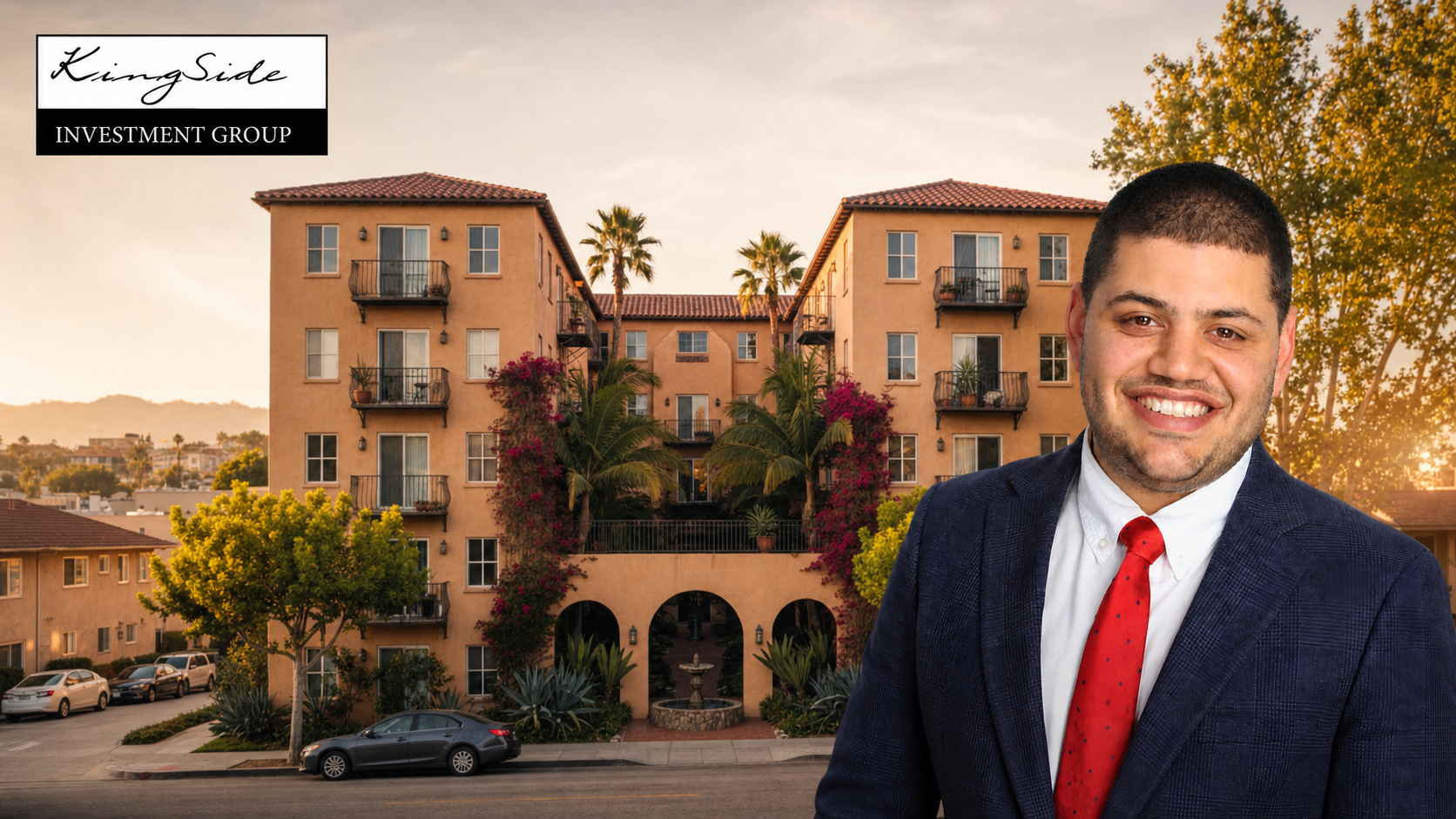
The best multifamily broker in Koreatown, Los Angeles is one who understands the neighborhood's specific cap rate range, knows how to price the dense RSO-covered stock between Wilshire and Olympic, and has an active buyer network that targets Koreatown specifically. Koreatown has one of the highest apartment building densities in Los Angeles, which creates both opportunity and risk: more buildings mean more buyer competition, but also more mismatched listings from generalist brokers who do not know the submarket.
Table of Contents
- What Does the Koreatown Apartment Building Market Look Like Right Now?
- What Cap Rate Do Koreatown Apartment Buildings Trade At?
- How Does Rent Control (RSO) Affect Koreatown Apartment Buildings?
- What Makes a Koreatown Multifamily Broker Different
- How Does Measure ULA Affect Koreatown Apartment Building Sales?
- How Kingside Investment Group Serves Koreatown Sellers
- What Do Recent Koreatown Apartment Building Sales Look Like?
- What Questions Should You Ask Before Hiring a Koreatown Multifamily Broker?
- Frequently Asked Questions
What Does the Koreatown Apartment Building Market Look Like Right Now?
Koreatown is bounded roughly by Vermont Avenue to the west, Normandie Avenue to the east, Beverly Boulevard to the north, and Pico Boulevard to the south. It spans ZIP codes 90005, 90006, and 90010. The neighborhood contains one of the highest concentrations of apartment buildings per square mile anywhere in Los Angeles County, with an estimated 15,000 to 20,000 rental units packed into a compact urban grid.
The housing stock is almost entirely pre-1978 construction, which means virtually every multifamily building in Koreatown falls under the Los Angeles Rent Stabilization Ordinance (RSO). Buildings range from small 4-unit bungalow courts built in the 1940s and 1950s to dense 20 to 40 unit mid-rise buildings constructed in the 1960s and early 1970s. The typical listing is a 6 to 12 unit building with a mix of one-bedroom and two-bedroom units, some below-market long-term tenants, and deferred maintenance.
Buyer demand in Koreatown remains consistently strong for several reasons. The submarket offers higher cap rates than Westside or coastal LA submarkets, making it accessible for 1031 exchange buyers who are rotating out of lower-yielding properties. The Korean-American investor community has deep ties to this neighborhood and actively competes for available inventory. Institutional value-add buyers targeting Los Angeles multifamily also include Koreatown on their acquisition lists because of the density of available product and clear repositioning potential through vacancy decontrol.
Koreatown's depth of buyer demand is what makes it a strong market for sellers, provided the listing is priced correctly and the broker has direct relationships with the right buyer pool. Listings that are overpriced or brought to market without preparation sit without offers, while well-structured transactions with strong rent roll documentation and accurate RSO disclosures can move quickly.
Koreatown Submarket at a Glance
ZIP codes: 90005, 90006, 90010. Primary building type: 4 to 40 unit pre-1978 multifamily. RSO coverage: near-universal (virtually all buildings). Measure ULA: applies only to transactions above $5M. Primary buyer profile: 1031 exchange buyers, Korean-American investors, value-add operators.
Get a Free Koreatown Apartment Building Valuation
Andres Diaz provides no-obligation valuations for Koreatown apartment buildings. Based on current cap rates, your rent roll, and comparable closed sales.
What Cap Rate Do Koreatown Apartment Buildings Trade At?
Cap rates in Koreatown have historically ranged from 4.5% to 5.5%, with the current market (2025-2026) clustering most stabilized transactions between 4.5% and 5.2%. The cap rate a specific building trades at depends heavily on building size, unit mix, rent roll strength, and the buyer's assessment of vacancy decontrol upside. A building with long-term tenants at 40% below market rents may trade at a higher cap rate than its stabilized NOI suggests, because buyers are pricing in future rent resets as units turn over.
The formula buyers use is straightforward: Value equals Net Operating Income divided by Cap Rate. A building with $120,000 in annual NOI at a 5% cap trades at $2.4 million. At a 4.5% cap, the same NOI produces a $2.67 million valuation. Understanding where on this range your building will trade requires knowing your actual NOI, not your gross rents, and requires a broker who tracks Koreatown-specific comparable sales data, not regional averages.
| Building Type | Current Cap Rate Range | Price Per Unit Range | Key Factor |
|---|---|---|---|
| 4-unit (near Wilshire or Koreatown Village) | 4.5% - 4.8% | $240,000 - $285,000 | High demand, limited supply; owner-user appeal |
| 6-unit (standard 1960s courtyard) | 4.7% - 5.1% | $210,000 - $255,000 | Bread-and-butter Koreatown investor product |
| 8 to 12 unit (mixed 1BR/2BR) | 4.8% - 5.2% | $190,000 - $240,000 | Vacancy decontrol upside drives buyer pricing |
| 12+ unit (mid-rise, high below-market exposure) | 5.0% - 5.5% | $175,000 - $220,000 | Measure ULA threshold risk; larger buyer pool |
The cap rate ranges above represent active market estimates based on Koreatown transaction activity in 2025 and early 2026. Individual buildings trade outside these ranges depending on deferred maintenance, soft-story retrofit status, active litigation, and other factors that a specialist broker accounts for in the pricing analysis.
Pricing the Decontrol Upside
When a tenant in an RSO unit vacates, the owner can reset the rent to market rate (Costa-Hawkins, Civil Code 1954.52). In Koreatown, where some long-term tenants pay 30% to 50% below market, this upside is often the single largest driver of buyer pricing. A specialist broker models decontrol scenarios and presents them to buyers explicitly, which frequently produces offers above a naive current-NOI cap rate analysis would suggest.
How Does Rent Control (RSO) Affect Koreatown Apartment Buildings?
The Los Angeles Rent Stabilization Ordinance (LAMC Chapter XV) covers buildings constructed before October 1, 1978. Because virtually all of Koreatown's multifamily stock was built before that date, RSO coverage is near-universal. RSO limits annual rent increases to a percentage set annually by the Los Angeles Housing Department (4% for 2025-2026) and requires just-cause grounds for eviction of covered tenants.
RSO affects apartment building values in Koreatown in two opposing ways. On the downside, it caps current income: a building with long-term tenants paying $900 per month for a two-bedroom unit that rents for $1,800 on the open market is generating half the income it could. On the upside, vacancy decontrol under Costa-Hawkins means each unit that turns over converts to market rate permanently. Buyers model this decontrol schedule in their acquisition underwriting, typically assigning a time value to projected turnover based on tenant age, unit size, and historical turnover rates for the submarket.
Sellers need to understand both sides of this equation before listing. A building where most tenants are long-term at well-below-market rents may actually generate more buyer interest than a fully stabilized building, because the decontrol upside gives buyers a clear path to returns. The challenge for sellers is extracting maximum value from that upside through accurate buyer-side modeling, which requires presenting the rent roll in a format that makes the gap between current and market rents transparent and credible.
| RSO Rule | What It Means for Sellers | Specialist Broker Action |
|---|---|---|
| Annual increase cap (4% for 2025-2026) | Below-market tenants stay below market until vacancy | Models decontrol timeline for each unit |
| Just-cause eviction required | Cannot accelerate vacancies without cause | Advises on legal voluntary vacancies and cash-for-keys |
| Costa-Hawkins (Civil Code 1954.52) | Vacancy allows full market rent reset | Presents decontrol upside model in offering memorandum |
| LAHD relocation fees (if no-fault eviction) | Significant cost if owner-initiated vacancy | Structures disclosures to avoid liability transfer to buyer |
RSO Questions? Talk to a Koreatown Specialist.
Andres Diaz has handled RSO-covered apartment building sales across Koreatown, Echo Park, and Pico Union. He can walk you through your rent roll, decontrol scenarios, and net proceeds.
What Makes a Koreatown Multifamily Broker Different
Koreatown apartment buildings are not residential properties. Pricing them correctly requires understanding cap rate methodology, NOI calculation, RSO exposure analysis, and Koreatown-specific buyer behavior. A residential broker who handles Koreatown condos and single-family homes will not have this knowledge. The pricing errors residential generalists make on Koreatown apartment buildings consistently cost sellers tens of thousands to hundreds of thousands of dollars, either through underpricing or through deal collapse when buyers discover RSO liabilities the listing broker did not surface in the offering.
The specific competencies that distinguish a Koreatown multifamily specialist include: the ability to calculate adjusted NOI from a raw rent roll, the knowledge to model vacancy decontrol scenarios for each unit, familiarity with soft-story retrofit completion rates in the submarket and how incomplete retrofits affect buyer financing, and direct relationships with the Korean-American investor community and 1031 exchange buyers who actively target Koreatown.
Koreatown Multifamily Specialist
- Prices to NOI and Koreatown cap rate comps
- Models RSO decontrol upside per unit
- Direct access to Korean-American investor network
- Structures offering memo for 1031 buyers
- Advises on soft-story retrofit and buyer financing
- Knows which blocks and corridors drive premium pricing
Residential Generalist Broker
- Uses $/sqft or CMA from single-family comps
- Does not model RSO rent gaps or decontrol
- Limited access to active multifamily buyer pool
- Not familiar with 1031 exchange buyer requirements
- May miss soft-story retrofit disclosures
- Cannot explain Measure ULA threshold impact
See our full analysis of this distinction in our article on residential agents versus multifamily brokers for LA apartment building sales. The pricing competency gap between the two is not marginal. On a $3M Koreatown building, a 5% to 10% pricing error from a generalist broker translates to $150,000 to $300,000 in proceeds left on the table.
The Korean-American Investor Network
Koreatown has one of the most active Korean-American real estate investor communities in LA County. Many of these buyers have multi-generational familiarity with the submarket, strong local banking relationships, and a preference for purchasing within walking distance of businesses and community institutions they know. A broker with established relationships in this community can present properties directly to buyers who will not appear on CoStar or Crexi, often before the listing goes public.
How Does Measure ULA Affect Koreatown Apartment Building Sales?
Measure ULA (Los Angeles Municipal Code Section 21.9.2) imposes a real property transfer tax on sales within the City of Los Angeles above specific thresholds. For residential and multifamily properties, the rates are 4% on the total sale price for transactions between $5 million and $10 million, and 5.5% on the total sale price for transactions above $10 million. Measure ULA does not apply below $5 million.
For the majority of Koreatown apartment buildings in the 4 to 12 unit range, Measure ULA is not a factor. Most of these buildings sell between $1 million and $4.5 million, well below the $5 million threshold. Sellers in this price band do not need to adjust their net proceeds for a ULA transfer tax.
However, for larger Koreatown buildings in the 16 to 40 unit range, Measure ULA can be material. A 20-unit building trading at $6 million generates a $240,000 ULA tax obligation for the seller (4% of $6M). At $8 million, the obligation is $320,000. These are significant closing costs that need to be factored into seller net proceeds calculations from the start of the listing conversation, not discovered at escrow.
| Sale Price Range | Measure ULA Rate | Estimated ULA Tax | Typical Koreatown Building Size |
|---|---|---|---|
| Under $5,000,000 | None | $0 | 4 to 12 unit (most Koreatown buildings) |
| $5,000,000 to $7,500,000 | 4% | $200,000 to $300,000 | 14 to 20 unit buildings |
| $7,500,001 to $10,000,000 | 4% | $300,000 to $400,000 | 20 to 30 unit buildings |
| Above $10,000,000 | 5.5% | $550,000+ on amount above $10M | 30+ unit buildings; rare in Koreatown |
Threshold Strategy for Borderline Listings
A building whose market value sits near $5 million presents a strategic decision. Pricing slightly below the Measure ULA threshold can be the correct move if the tax savings for the seller exceed the premium that might be achievable from a buyer who is not price-sensitive to the threshold. This analysis requires a specialist broker who can model both scenarios and advise based on actual buyer pool behavior in Koreatown.
How Kingside Investment Group Serves Koreatown Sellers
Kingside Investment Group is a Los Angeles multifamily brokerage focused exclusively on apartment building sales in LA County. The firm's 169 closed transactions totaling $336.5M in volume include multiple closed sales in Koreatown's dense apartment building corridor. Andres Diaz, Managing Director of Multifamily Investments, has worked with Koreatown apartment building owners on transactions ranging from small 4-unit bungalow courts near Normandie to larger mid-rise buildings on Wilshire Boulevard.
Kingside's process for Koreatown sellers begins with a no-obligation valuation that incorporates current Koreatown cap rate data, a unit-by-unit analysis of the rent roll relative to market rents, a Measure ULA threshold review if the building is in the relevant price range, and a projection of net proceeds after all transaction costs. This is delivered before any listing agreement is signed, because Kingside's position is that sellers should understand what they will net before committing to the process.
On the buyer side, Kingside maintains active relationships with Korean-American investors who specialize in Koreatown, 1031 exchange buyers from across the LA basin who target this submarket, and value-add operators who acquire buildings with below-market rents and manage the decontrol process over a five to ten year hold. This network produces offers that are grounded in Koreatown-specific underwriting, which means fewer deal collapses from buyer due diligence surprises.
For the broader context of what separates a specialized multifamily broker from a generalist, see our hub article on the best multifamily broker in Los Angeles. Koreatown-specific knowledge, built on a record of 169 closed transactions totaling $336.5M across LA County, is the defining component of that specialist advantage in this submarket.
Ready to Sell Your Koreatown Apartment Building?
Call Andres Diaz for a straightforward conversation about your building's value, your RSO exposure, and what a realistic sale timeline looks like in today's market.
What Do Recent Koreatown Apartment Building Sales Look Like?
Koreatown's transaction volume has remained active through the 2024-2026 interest rate cycle. While rising rates reduced transaction counts across most LA submarkets, Koreatown maintained deal flow because the submarket's cap rates are high enough to support buyer returns even at the higher cost of capital. Buyers who could no longer make the math work in Westside submarkets at 3.5% to 4.0% cap rates found Koreatown's 4.5% to 5.2% range sufficient to proceed.
The most active transaction segments in Koreatown have been 6 to 12 unit buildings in the $2 million to $4 million range. These buildings attract competition from multiple buyer types: Korean-American investors who know the submarket well, 1031 buyers rotating out of properties in other LA neighborhoods, and smaller value-add operators who can manage a 10 to 12 unit building without institutional infrastructure. This buyer depth keeps pricing competitive.
Larger buildings in the 20 to 40 unit range have transacted more selectively. Some owners of larger buildings have held back from selling specifically because of Measure ULA's 4% transfer tax, preferring to wait for potential modification or repeal. Others have transacted, absorbing the tax and netting strong prices because the underlying demand from institutional value-add buyers has remained steady. A specialist broker can model both scenarios.
| Building Size | Typical Price Range | Dominant Buyer Type | Sale Timeline |
|---|---|---|---|
| 4 unit | $900K - $1.4M | Owner-user, first-time investor, Korean-American buyer | 30 to 45 days to contract |
| 6 unit | $1.4M - $2.2M | 1031 exchange buyer, Koreatown investor community | 30 to 50 days to contract |
| 8 to 12 unit | $2.2M - $4.5M | 1031 buyer, value-add operator, private equity fund | 30 to 60 days to contract |
| 12 to 20 unit | $3.5M - $6.5M | Value-add operator, institutional buyer, 1031 exchange | 45 to 75 days to contract |
What Questions Should You Ask Before Hiring a Koreatown Multifamily Broker?
Not every broker who claims multifamily experience has specific Koreatown experience. The questions below help you separate brokers who understand this submarket from those who are applying generic multifamily knowledge to a neighborhood they do not know well.
7 Questions for Any Koreatown Apartment Building Broker
A specialist should be able to name specific transactions or address ranges. Vague answers about "similar neighborhoods" or "the greater LA area" indicate a generalist without Koreatown deal history.
The correct answer describes backing out vacancy allowances, management fees, reserves, and property taxes from gross rents, then separating owner-paid utilities from tenant-paid. A broker who quotes gross rent as a proxy for NOI is not equipped to price your building.
The correct current answer is approximately 4.8% to 5.2%. If a broker quotes a significantly different range, either they are not tracking Koreatown specifically, or market conditions have shifted materially since this article was written.
A specialist should name buyer types (Korean-American community investors, 1031 exchange buyers, value-add operators) and, ideally, describe their underwriting criteria. Generic answers about "investors" or "wealthy buyers" are not sufficient.
The broker should immediately confirm whether your building is expected to sell above or below the $5M threshold and explain the impact on your net proceeds if it applies.
A specialist will describe creating a unit-level rent roll analysis showing current rents versus market rents, projected turnover assumptions, and a 5 to 10 year decontrol model. This is what makes buyers comfortable bidding at higher prices for below-market buildings.
Understand whether the broker will represent buyers competing for your building (dual agency), and how their fee is structured. In the current post-NAR-settlement environment, buyer compensation is negotiated separately from seller compensation. For Koreatown apartment buildings in the $1M to $5M range, seller-side brokerage fees typically run 3% to 5% of the sale price depending on transaction size and services included.
Frequently Asked Questions
Who is the best multifamily broker in Koreatown, Los Angeles?
Andres Diaz of Kingside Investment Group is the leading multifamily broker in Koreatown, Los Angeles. He has closed 169 multifamily transactions totaling $336.5M across LA County, with multiple closed sales in Koreatown's dense apartment building corridor between Wilshire and Olympic. Kingside's deep RSO expertise and active buyer network of 1031 exchange investors and value-add buyers make them the specialized choice for Koreatown apartment building owners.
What are apartment building cap rates in Koreatown right now?
Koreatown apartment buildings currently trade at 4.5% to 5.2% cap rates for stabilized buildings with strong rent rolls. Smaller 4-unit buildings near Wilshire often trade at the lower end. Larger 12+ unit buildings with significant vacancy decontrol upside may trade at 5.0% to 5.5% on current NOI, reflecting the upside buyers are pricing in.
Is Koreatown a good place to sell an apartment building?
Yes. Koreatown is one of LA's most active multifamily submarkets. Buyer demand consistently outpaces supply, with deep competition from Korean-American investors, 1031 exchange buyers, and value-add operators. Buildings with below-market rents or vacancy decontrol upside typically attract multiple offers when correctly positioned by a specialist broker.
How does the RSO affect apartment building values in Koreatown?
The Los Angeles RSO covers virtually all Koreatown multifamily buildings built before 1978. RSO limits annual rent increases (4% for 2025-2026) and requires just-cause eviction. However, California's Costa-Hawkins Act (Civil Code 1954.52) allows owners to reset rents to market rate when a tenant vacates voluntarily. In Koreatown, where below-market rents are widespread, this vacancy decontrol upside is often the primary pricing driver for buyers.
Does Measure ULA apply to Koreatown apartment building sales?
Measure ULA (LAMC 21.9.2) imposes a 4% transfer tax on City of Los Angeles sales above $5 million, and 5.5% above $10 million. Most Koreatown apartment buildings in the 4 to 12 unit range sell below $5 million and are not subject to Measure ULA. Larger buildings above $5 million will trigger the 4% tax, which must be factored into seller net proceeds.
How many apartment buildings sell in Koreatown each year?
Estimates based on CoStar and Crexi data suggest 60 to 100 apartment building transactions close annually in Koreatown (ZIP codes 90005, 90006, 90010). Transaction volume fluctuates with interest rates, but demand from 1031 buyers and value-add investors has kept deal flow consistent even in higher-rate environments.
What is the price per unit for apartment buildings in Koreatown?
Price per unit in Koreatown generally ranges from $175,000 to $285,000 depending on building size, condition, and rent roll strength. Smaller 4-unit buildings in well-maintained condition on strong blocks tend to trade at the upper end. Larger 12+ unit buildings with deferred maintenance or below-market rents often trade at $175,000 to $225,000 per unit.
How do I find investors who buy apartment buildings in Koreatown?
The most effective approach is through a broker who maintains a dedicated Koreatown investor database. Kingside Investment Group maintains relationships with Korean-American investors, 1031 exchange buyers from across the LA basin, and value-add buyers who actively target Koreatown. Listing on CoStar and Crexi reaches additional buyers, but Kingside's direct network outreach often produces faster and better results.
How long does it take to sell an apartment building in Koreatown?
A well-priced Koreatown apartment building typically goes under contract within 30 to 60 days of coming to market. Escrow runs 30 to 45 days for standard transactions, extending to 60 to 90 days for 1031 exchange buyers or complex RSO due diligence. Total time from listing to close is typically 60 to 120 days in the current market.
Related Kingside Resources
See also: Best Multifamily Broker in Los Angeles (hub article) | How to Sell an Apartment Building in Koreatown, Los Angeles | Residential Agent vs. Multifamily Broker: Who Should Sell Your LA Apartment Building? | LA Apartment Building Cap Rates 2025-2026 | Rent Control Laws for LA Apartment Building Owners
Talk to Andres Diaz About Your Koreatown Building
No obligation. Andres will review your rent roll, give you an honest valuation based on current Koreatown cap rates, and walk through what your net proceeds would look like after all transaction costs.

.png)