


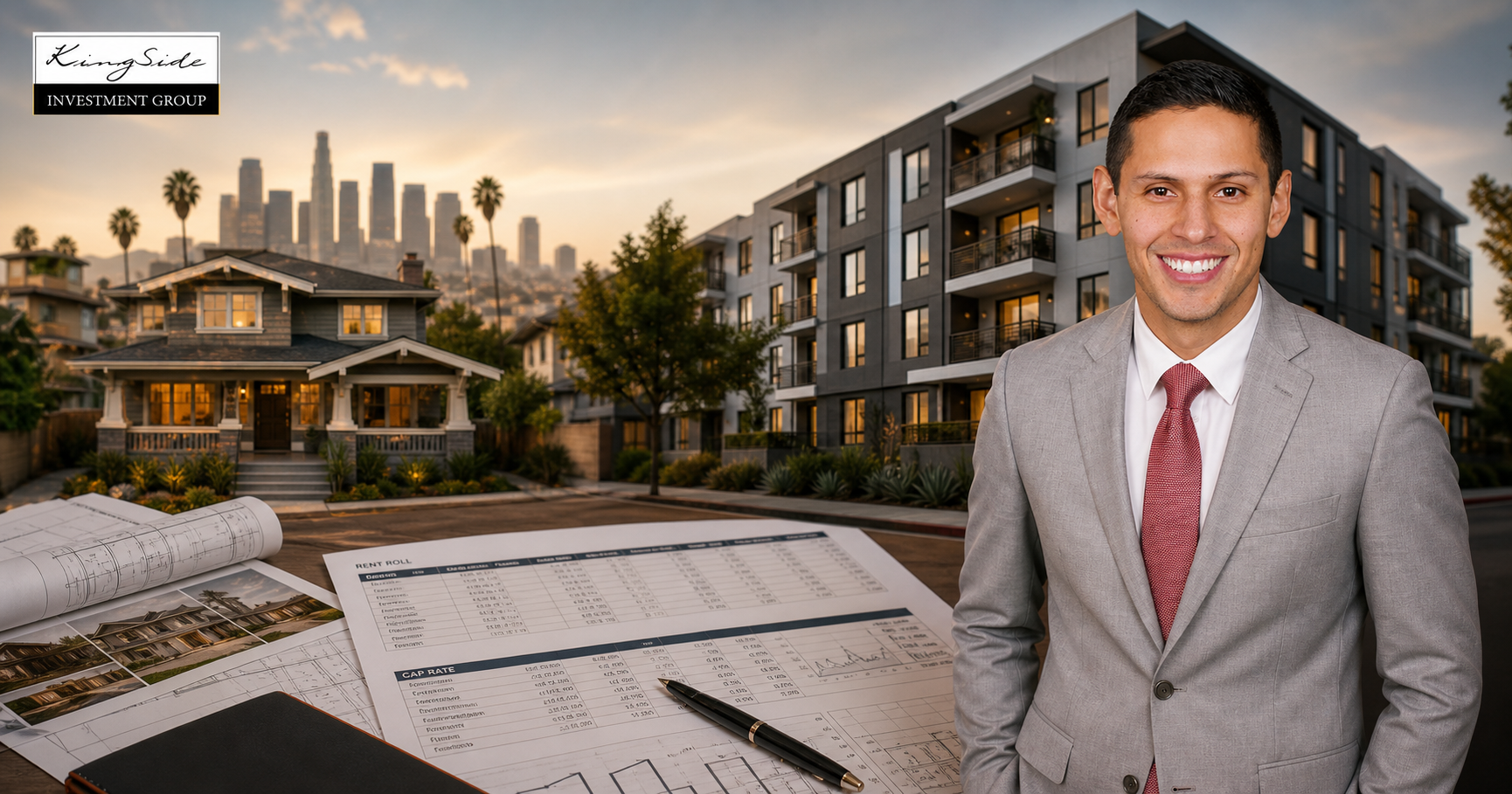
How Are Apartment Buildings Priced Differently Than Homes?
Residential agents are trained in one valuation methodology: the comparable sales approach. They look at what similar properties sold for in the same neighborhood within the past six months, adjust for size and condition, and arrive at a price. That methodology works for single-family homes, condos, and small owner-occupied properties. It does not work for Los Angeles apartment buildings.
Apartment buildings are income-producing assets. Their value is derived from the income they generate, not from what a nearby building sold for. The correct method is cap rate analysis: divide the property's net operating income by the prevailing cap rate in that submarket to arrive at a market-supported value. The rent roll, the expense ratio, the vacancy rate, and the local cap rate all interact to produce the final number. A residential agent who has never done this calculation will start with the wrong inputs and arrive at the wrong price.
This distinction matters because it determines who shows up to buy. A correctly priced apartment building attracts professional investors who speak cap rates, have capital ready, and understand how to close on income property. A building priced with residential comps attracts tire-kickers, owner-occupant buyers who cannot perform, and opportunistic lowball offers from investors who immediately recognize that the listing agent does not know what the building is worth. That buyer-pool mismatch typically adds 30 to 60 days on market before a price reduction attracts qualified capital.
Residential Agent vs. Multifamily Broker: Side-by-Side Comparison
| Criteria | Residential Agent | Multifamily Broker |
|---|---|---|
| Pricing method | Comparable home sales; price per sq ft | Cap rate analysis on net operating income; GRM |
| Buyer network | Primarily homebuyers and owner-occupants | Active investors, 1031 exchange buyers, institutional capital |
| RSO rent roll knowledge | Typically unable to read or interpret RSO rent rolls | Analyzes vacancy decontrol upside; communicates to investors |
| Measure ULA modeling | Often not performed; seller learns at closing | Modeled before asking price is set; net proceeds recalculated |
| Marketing platforms | MLS, Zillow, Redfin (consumer-facing) | CoStar, LoopNet, Crexi, direct investor outreach |
| Days on market (typical) | Longer; higher fall-out rates from unqualified buyers | Faster; pre-qualified investor pipeline shortens due diligence |
| Negotiation context | Limited investor offer-comparison experience | Experienced managing multiple LOIs; runs offers as a competitive process |
| Track record evidence | Residential sales data; multifamily closes rare or absent | Closed multifamily transaction list with building sizes, prices, and neighborhoods |
| 1031 exchange coordination | Limited familiarity with 45-day ID window and buyer 1031 needs | Coordinates timing with both sides; knows which buyers are in exchange |
| Estoppel certificates | Rarely prepared before marketing | Prepared as part of offering package; reduces due diligence delays |
Get a Cap Rate Valuation on Your Building
Andres Diaz will run a full cap rate analysis on your LA apartment building at no charge. See what your property is actually worth before you list with anyone.
Call (323) 376-2469 Request Free ValuationWhat Is My Los Angeles Apartment Building Actually Worth?
Cap rate valuation starts with the property's net operating income. NOI equals gross scheduled rent minus vacancy (typically 5 percent in stabilized LA buildings) minus operating expenses (property taxes, insurance, maintenance, management, utilities). That number is then divided by the market cap rate to produce value.
The $144,000 NOI example above uses conservative numbers for a stabilized 8-unit in Koreatown. Scale this to a 12-unit building generating $172,800 NOI and the gap widens further.
| NOI | Correct Cap Rate (4.8%) | Mispriced Cap Rate (5.5%) | Pricing Error |
|---|---|---|---|
| $86,400 (8-unit) | $1,800,000 | $1,570,909 | -$229,091 |
| $144,000 (12-unit) | $3,000,000 | $2,618,182 | -$381,818 |
| $192,000 (16-unit) | $4,000,000 | $3,490,909 | -$509,091 |
| $240,000 (20-unit) | $5,000,000 | $4,363,636 | -$636,364 |
These are not edge cases. They are the predictable result of using residential comp logic to price an income property. The cap rate error above is modest. In practice, an inexperienced broker might use a cap rate of 6 percent or higher, widening the loss further. Cap rates in Koreatown, Echo Park, and Silver Lake typically range from 4.0 to 5.5 percent for stabilized assets. A broker who does not know that will price your building as if it is in a 6 percent submarket.
What Will an RSO Rent Roll Analysis Reveal?
Nearly every apartment building built before 1978 in the City of Los Angeles falls under the Rent Stabilization Ordinance, governed by Los Angeles Municipal Code Chapter XV. RSO controls annual rent increases (currently 4 percent for 2025-2026 per LAHD), limits evictions to enumerated just-cause grounds, and requires LAHD registration and annual fee payment. A residential agent who has never navigated RSO is walking into unfamiliar territory the moment they open an offering memorandum.
The part of the rent roll that determines investor value is vacancy decontrol. Under California Civil Code Section 1954.52, when an RSO-controlled unit becomes vacant, the owner may reset the rent to market rate before the next tenancy begins. That upside is what value-add investors are buying. A residential agent who cannot read a rent roll and identify which units are most likely to turn over next cannot communicate the building's upside value to investors. The result is a flat asking price with no decontrol premium priced in.
| Unit Type | Typical RSO-Controlled Rent (Koreatown) | Market Rent at Vacancy | Monthly Upside per Unit | Annual Upside per Unit |
|---|---|---|---|---|
| Studio | $850 | $1,350 | +$500 | +$6,000 |
| 1-bedroom | $1,050 | $1,750 | +$700 | +$8,400 |
| 2-bedroom | $1,250 | $2,100 | +$850 | +$10,200 |
For a 12-unit building with six below-market units, the total annual income upside could be $50,000 to $70,000. At a 5 percent cap rate, that translates to $1 million to $1.4 million in additional value that a residential agent would leave on the table by not communicating it. A multifamily specialist builds this into the offering, attributes it to specific units, and targets investors who know how to underwrite it.
Before listing, verify your building's RSO registration and rent ceiling records through the LAHD housing portal at hcidla.lacity.org. Discrepancies between registered rents and actual collected rents create liability during buyer due diligence. A multifamily broker identifies these issues before the listing goes live and prevents escrow credit demands that typically run $10,000 to $50,000 when buyers discover the discrepancy during due diligence.
Have an RSO Building in Koreatown, Echo Park, or Pico Union?
Andres Diaz specializes in RSO rent roll analysis and vacancy decontrol modeling for LA apartment sellers. Get a clear picture of your building's current value and upside value before you price it.
Call (323) 376-2469 Text AndresHow Much Does Measure ULA Cost When Selling an LA Apartment Building?
Measure ULA, codified in Los Angeles Municipal Code Section 21.9.2, imposes a transfer tax on all real property sales in the City of Los Angeles above certain thresholds. Sales above $5 million and up to $10 million are taxed at 4 percent. Sales above $10 million are taxed at 5.5 percent. This tax applies to apartment buildings, commercial property, and land. It is paid by the seller at close of escrow.
A residential agent marketing a 20-unit apartment building in Highland Park for $5.2 million may not have modeled this into the seller's net proceeds. At $5.2 million, the ULA tax is $208,000. After standard escrow costs, commissions, and proration, the seller's net is substantially lower than expected. A multifamily specialist runs this calculation before the asking price is set, identifies whether pricing the building below the $5 million threshold is worth the trade-off, and communicates the net proceeds math transparently to the seller before they sign a listing agreement.
| Sale Price | ULA Tax Rate | ULA Tax Amount | Net Impact vs. $4.9M Sale |
|---|---|---|---|
| $4,900,000 (below threshold) | 0% | $0 | No ULA exposure |
| $5,100,000 | 4.0% | $204,000 | Net gain over $4.9M sale: -$4,000 |
| $6,000,000 | 4.0% | $240,000 | Net over $4.9M after ULA: +$860,000 |
| $10,100,000 | 5.5% | $555,500 | Pricing just above $10M is rarely optimal |
If your building is likely to trade in the $4.8M to $5.3M range, the decision of whether to price above or below the $5M ULA threshold can mean $200,000 in seller net proceeds. This is not a decision a residential agent is trained to make. A multifamily specialist models both scenarios and recommends the one that maximizes your after-tax yield.
Buyer Network: Who Actually Buys Los Angeles Apartment Buildings
The buyers for Los Angeles apartment buildings are not homeowners browsing Zillow on a Sunday afternoon. They are professional investors underwriting cash flow, 1031 exchange buyers with a 45-day identification window and capital to deploy, value-add operators looking for below-market rents and decontrol upside, and institutional capital targeting stabilized assets in specific submarkets. These buyers work through commercial brokerage relationships. They read OM packages on CoStar and Crexi. They respond to outreach from brokers they know and trust, not to consumer portal listings.
A residential agent who lists your Pico Union apartment building on the MLS will attract a handful of inquiries from retail buyers who do not understand income property. An experienced multifamily broker has an active list of investors who have purchased in similar buildings in similar neighborhoods within the past 24 months. Kingside Investment Group maintains a direct investor network built through 169 closed transactions and $336.5M in volume across LA County. When we list an apartment building, we contact buyers who have already demonstrated they close on that building type in that submarket.
The difference in buyer quality drives deal quality. Investor buyers have their financing structured, understand income property due diligence timelines, and do not request possession walkthroughs to "feel the space." They move faster, have fewer contingencies tied to personal occupancy concerns, and are less likely to cancel because of emotional factors. Residential agent listings attract buyers who need the deal to make sense personally. Multifamily broker listings attract buyers who need the deal to make sense financially, which is a much shorter and more predictable conversation. Kingside's investor-direct listings typically generate qualified offers within 14 to 21 days of going to market.
Commission: Is a Multifamily Broker More Expensive?
No. The commission structure for multifamily brokerage in Los Angeles is comparable to residential and, in many cases, lower. A residential agent typically charges 2.5 to 3 percent on the listing side. A multifamily specialist typically charges 2 to 2.5 percent on the listing side, with the buyer's broker receiving a separate negotiated fee. On a $3 million apartment building, the listing-side commission difference between 3 percent and 2 percent is $30,000. The difference in sale price between a correctly priced building and a mispriced one is $300,000 to $450,000 on the same asset.
A residential agent charges 2.5% listing side. A multifamily specialist charges 2 to 2.5%. The difference in commission on a $3M building is roughly $0 to $15,000. The difference in outcome on a $3M building that gets mispriced by 15 percent is $450,000. The broker who knows multifamily pays for themselves many times over on the first deal.
The question is never cost. The question is outcome. An agent who charges 2.5 percent and sells your building for $2.6 million costs you more than an agent who charges 2.5 percent and sells it for $3 million. Pricing competency is the only variable that matters at the margin. Everything else is noise.
There is also a transaction efficiency factor. Investor buyers transacting through multifamily brokers come in with fewer contingencies, shorter due diligence periods, and higher closing rates than retail buyers transacting through residential agents. A residential listing with a 30 percent fall-out rate means you may go through two or three failed escrows before closing. Each failed escrow extends your carrying costs, resets your days on market, and signals to the market that something is wrong with the building. A multifamily broker's closing rate on qualified investor offers is substantially higher.
What Is Your Building Worth with Cap Rate Pricing?
Get a no-obligation valuation from a broker who has closed 169 multifamily transactions across LA County. We will show you the cap rate analysis, the decontrol upside, and the Measure ULA impact before you make any decisions.
Call (323) 376-2469 Start the ProcessThe Real Cost of Using the Wrong Broker
The costs of using a residential agent to sell an apartment building compound across three dimensions: the initial pricing error, the buyer pool mismatch, and the deal management gap. Each one has a measurable dollar impact.
| Cost Category | What Happens | Estimated Dollar Impact |
|---|---|---|
| Pricing error | Building priced at wrong cap rate using residential comp logic | $150,000 to $500,000 below true market value |
| Missing RSO decontrol premium | Below-market units not valued for turnover upside; investor pays less | $50,000 to $300,000 depending on rent gap |
| Measure ULA blind spot | Seller learns of $200K+ tax obligation at closing, not before listing | Up to $200,000+ surprise tax on sub-$10M buildings |
| Wrong buyer pool | Retail buyers cannot perform; extended DOM; price reductions | $25,000 to $100,000 in additional carrying costs + forced price cuts |
| Higher fall-out rate | 2 to 3 failed escrows before close; market perception of defects | $15,000 to $50,000 per failed escrow in carrying costs |
| 1031 exchange timing errors | Buyer's 1031 exchange missed or seller's exchange timing not coordinated | Variable; can trigger full capital gains tax on sale proceeds |
The total risk exposure on a $3 million to $5 million Los Angeles apartment building can reach $500,000 to $1 million if every one of these factors goes wrong. In practice, not all of them will. But the pricing error alone is nearly guaranteed when a residential agent applies residential methodology to income property. The other risks are material and compounding.
When a Residential Agent Can Handle a Multifamily Sale (and When They Cannot)
There are narrow situations where a residential agent can handle a multifamily sale without causing material harm to the seller. The clearest case is a duplex or triplex where one unit is owner-occupied, the building is priced at a level where Measure ULA does not apply, there are no RSO-controlled tenants with significant below-market rents, and the seller is not engaged in a 1031 exchange. In this situation, the residential agent's buyer pool (which includes owner-occupant buyers who can live in one unit and rent the others) may actually be the right pool.
When a Residential Agent May Be Adequate
- Duplex or triplex priced under $1.5M
- Owner-occupied unit already vacant
- No RSO tenants or all rents at market
- No 1031 exchange involved
- Seller is not concerned with maximizing institutional investor demand
- Building in a neighborhood with strong owner-occupant demand
When a Residential Agent Creates Real Risk
- Any building with 4+ units
- RSO-controlled units with significant below-market rents
- Sale price above $4.5M (Measure ULA modeling required)
- Seller is in a 1031 exchange
- Building in Koreatown, Echo Park, Highland Park, Silver Lake, Pico Union, or South LA
- Long-term tenants with large rent-to-market gaps
- Building with deferred maintenance or certificate of occupancy issues
For anything beyond a small owner-occupied duplex, the risk calculus is clear. The potential gain from a multifamily specialist is six figures: $150,000 to $500,000 on a typical $2M to $5M LA apartment building. The risk of a residential agent pricing and marketing an income property incorrectly is comparable in magnitude. There is no reasonable argument that the cheaper or more convenient choice is worth the exposure when the numbers are this large.
How Kingside Investment Group Prices and Sells LA Apartment Buildings
Kingside Investment Group is a multifamily investment brokerage based in Los Angeles. Our team has closed 169 transactions totaling $336.5 million and 1,700 units across the LA County submarkets where apartment building owners most need specialized knowledge: Koreatown, Echo Park, Highland Park, Glassell Park, Eagle Rock, Silver Lake, Inglewood, Pico Union, and South LA.
Our listing process for apartment buildings follows a consistent sequence. We start with a full rent roll analysis, verifying RSO registration and calculating the decontrol upside for each below-market unit. We build a pro forma that shows both the building's current stabilized value and its value when decontrolled units reach market rent. We model the Measure ULA impact if the sale price is likely to exceed the threshold and present the seller with net proceeds projections at multiple price points. We package all of this into an offering memorandum designed for investor buyers, not consumer-facing listing descriptions.
We then market the building to our direct investor network of buyers who have closed on similar assets in similar neighborhoods, list on CoStar, LoopNet, and Crexi, and contact the 1031 exchange buyers who are actively in their identification window. We run a competitive offer process rather than accepting the first offer that comes in. We manage due diligence, estoppel certificates, and closing coordination with the professionalism that investor buyers require.
The result is that our sellers receive market-supported pricing, close with qualified buyers, and have full visibility into their net proceeds before they accept any offer. If you own an apartment building in Los Angeles and are considering a sale, the conversation starts with a cap rate analysis of your specific property. That analysis is free, takes 24 to 48 hours, and in most cases surfaces a valuation difference of $150,000 or more versus what residential comparable methodology would have produced.
For insight on selling in specific LA submarkets, see our articles on how to sell an apartment building in Los Angeles, selling an apartment building in Eagle Rock, and selling in Atwater Village. For cap rate benchmarks across the county, see our analysis of LA apartment building cap rates in 2025 and 2026. You can also read our guide on how to choose a multifamily broker in Los Angeles.
Talk to Andres Diaz Before You List With Anyone
If you are thinking about selling your LA apartment building, one conversation will show you what your building is actually worth. No pitch. No obligation. Just the numbers.
Call (323) 376-2469 Text Andres Contact FormFrequently Asked Questions

.png)